Keokuk Union Depot Restoration Activity |
|
|
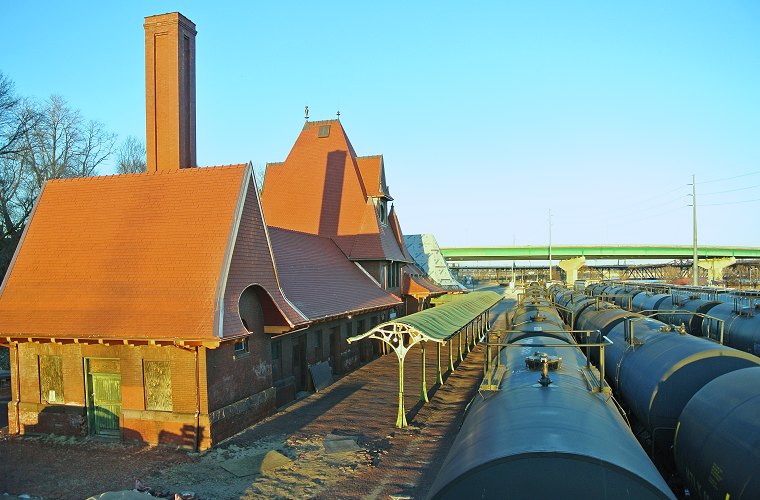
Erected beginning in 1891, the Keokuk Union Depot served the train-traveling public well for nearly eight decades. During that period the building was maintained in serviceable condition and underwent interior remodeling as requirements changed. With the cessation of passenger service to Keokuk in 1967, however, the structure was no longer needed for its primary mission. It was put to use for other purposes for which it was not intended, such as storage of surplus railroad equipment. Except for a brief period when the Depot served as a base for the original Keokuk Junction Railway's tourist operation, during which the waiting room was renovated, the structure was neglected. Locate the Depot on the map. In 2011, however, responsibility for the Depot passed to the City of Keokuk. Since then, activity has been under way to restore this historic structure and enhance its usefulness as a community resource. This page highlights some of the ongoing efforts in that direction.
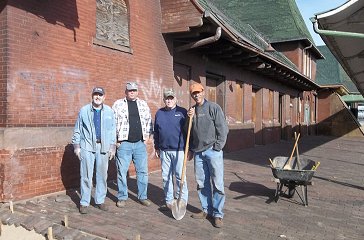
An early project, undertaken by Depot volunteers, was the relaying of the brick platform. Motor vehicle traffic in connection with railroad operations had caused the paving to sink and form ruts. During the summer of 2012 the bricks were pulled up, new sand was laid down and leveled, and the bricks were reset from the northeast end of the building to the southwest, between the building and the train shed support posts. In the photo below, volunteers pose on December 4, 2012 when that goal was reached.
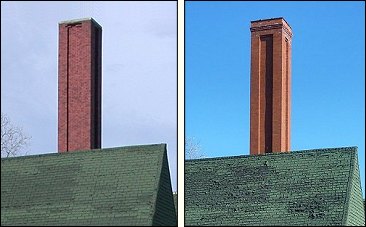
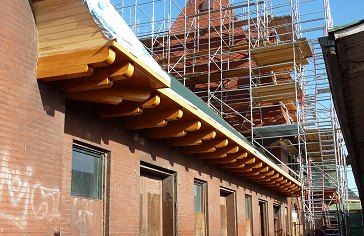
The major activity of 2015 included the restoration of the eaves and gutters around the waiting room and the restoration of the chimney to its original height. This project was supported in part by the Iowa Department of Cultural Affairs' Historical Resource Development Program (HRDP); the contractor was Restoric LLC (then of Chicago, now of Michigan City, Indiana). This was the first step in a three-phase roof restoration project for which the Jeffris Family Foundation issued a challenge grant in 2014. By 2016 contributors had matched the grant enabling work to go forward. In 2016 the eaves were restored around the remainder of the building.
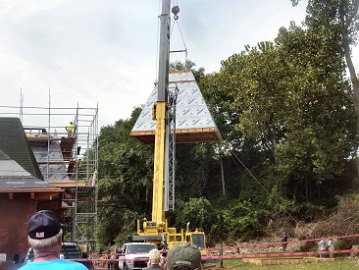
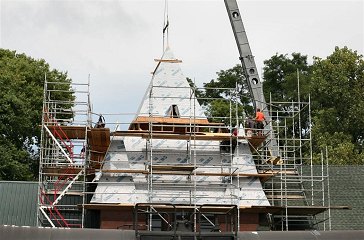
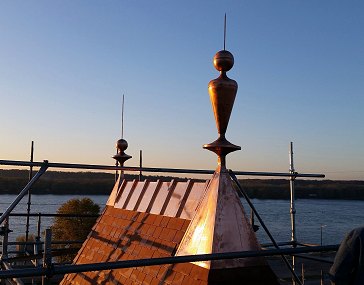
The focus of activity in 2016 was the construction and lifting of the apex to the central tower, which had been leveled off around 1950. The Meyer Guild of Chicago, subcontracted by Restoric LLC, built the new apex on the ground. On August 31, 2016, McDowell Crane & Rigging lifted the apex to the top of the central tower, adding 26 feet to the height of the building.
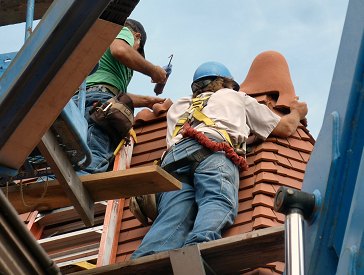
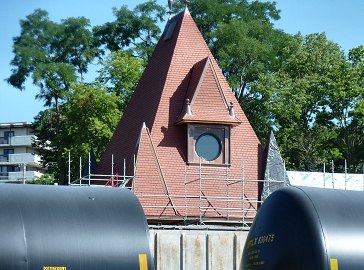
The central tower was rebuilt to provide additional support for the apex once it was in place. At the same time the four corner turrets, removed around 1950, were reconstructed. During the fall of 2016 the roof of the entire central tower was tiled, after construction of the dormers on both the track and bluff sides. (See the photos below and on the home page.) Brass finials were applied to the peak of the tower and the reconstructed corner turrets.
Roof repair and tiling on the up-river and down-river ends of the building was undertaken in 2017, and completed in 2018 (see the photo at the bottom of this page). For more information about the roof restoration project, visit the Depot Foundation page.
The 1891 plan for the Depot called for a clock to be installed in the dormer of the central tower, on both the track side and bluff side. No clock was ever installed, and until truncation of the tower in the 1950s the opening was filled in with wood. In 2017, after reconstruction of the dormers, the round window was glazed.
Municipal tax moneys are not used for Depot rehabilitation. The Depot Commission of the City of Keokuk administers the general efforts, but the Keokuk Union Depot Foundation is charged with raising the needed funds. Viewers interested in supporting the effort may contribute through the Foundation. Email the Foundation at keokukdepot@gmail.com, or send your contribution to Keokuk Union Depot, P.O. Box 463, Keokuk, IA 52632. The Dwell Magazine Award and Video
On March 8, 2012, Dwell Magazine, a San Francisco architectural publication, announced that the Keokuk Union Depot was the winner of the $10,000 "Rethinking Preservation" award sponsored by SubZero.
A team from Dwell visited Keokuk in May 2012 and created a five-minute video, Preserving the Keokuk Union Depot. An article on the project appeared in the October 2012 issue of Dwell. The Dwell award underwrote the Historic Structure Report that guides ongoing restoration efforts.
|
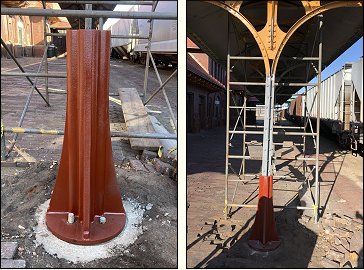
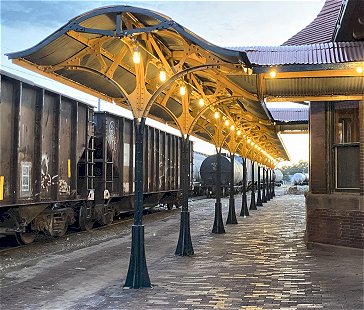
A second challenge grant from the Jerffris Family Foundation, initiated in 2020, enabled further exterior and interior restoration efforts. Work on the train shed (canopy) began in 2021 with removal of lead paint and repainting of the roof, both top and bottom, by a Quincy, Illinois firm. Some bases that support the roof columns were refabricated by an Alabama firm using an intact base as a pattern, and reset late in 2021. In March 2022 the columns were reinstalled connecting the bases to the roof structure. Members of the Keokuk Fire Department donated their services to repaint the metal work.
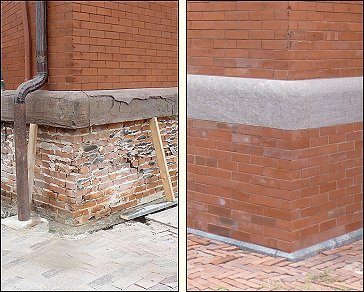
The sandstone blocks surrounding the building, under the windows (known architecturally as the "water table") had weathered badly through the decades and were replaced by a contractor in 2023-24. At the same time the lower brickwork and granite mudsill were replaced with new materials.
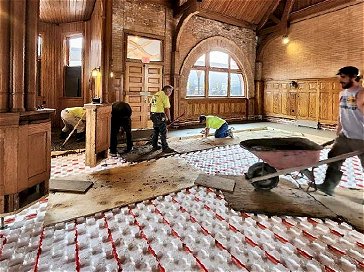
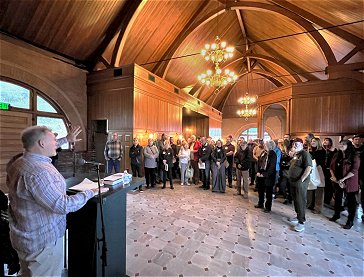
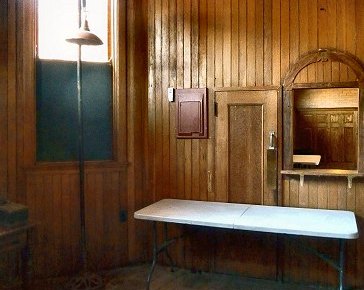
Restoration of the waiting room interior became the priority project from 2024-2026. The terrazzo floor, installed around 1950, was removed and replaced with a new floor incorporating a radiant heating installation for eventual use. Floor tiles replicating the 1891 originals were installed over a new concrete base.
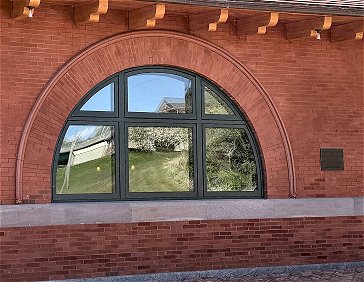
The arched windows of the waiting room were rebuilt by a local firm beginning in 2024. The rebuilding features protective glass, removing the need to protect the windows with plywood inserts during periods of non-occupancy.
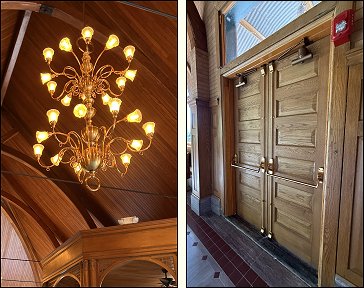
Chandeliers were installed in the waiting room in 2024, created in a design intended to replicate the style current in 1891 when the Depot was built. Exit doors were rebuilt to open outward and fitted with crash hardware for increased safety during events.
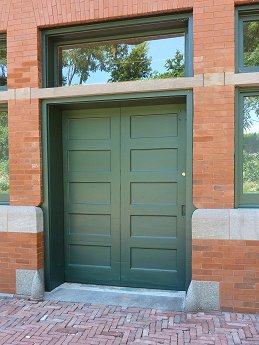
Over the years Depot volunteers have undertaken several minor projects not requiring a professional contractor. Included in this program have been the refinishing of several exterior doors, including the bluff side entrance to the baggage room which was reconditioned in 2024.
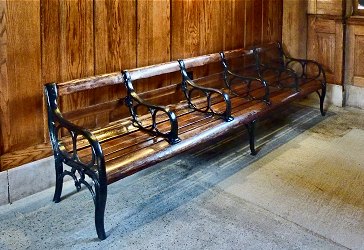
Original waiting room benches were present in the Depot until shortly before it was leased to the City of Keokuk, but by the time the City had access to the building they had been removed. A friend of the Depot loaned several benches appropriate to the period of the Depot's use in passenger service. Volunteers reconditioned them to restore an authentic appearance to this interior space. (Happily, the original benches were also returned early in 2019 and are in storage at the Depot.)
|
|
|
|
 The Depot topped a list of 118 entries on behalf of architectural landmarks. Christen Sundquist Martin, architectural intern from the School of the Art Institute of Chicago, entered the Depot in the competition because of its distinction as one of the few remaining depots designed by Burnham and Root. School students from the Keokuk area were instrumental in swelling the vote total for the Depot.